


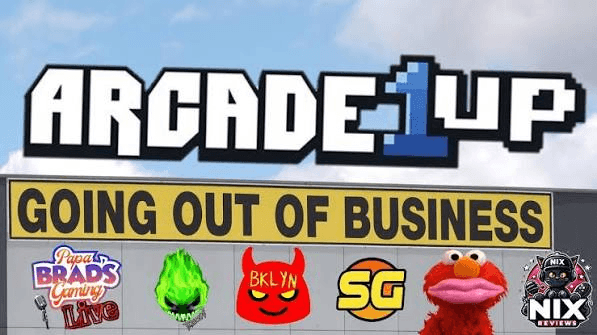
In December 2025, a leaked internal email began circulating across Reddit, YouTube, and gaming forums with a striking message: Arcade1Up was closing operations, and for most employees, Friday would be their last day.
The post spread quickly. Some declared the brand permanently dead. Others were more cautious. And through it all, Arcade1Up itself stayed largely silent.
So what is actually happening? This article breaks down what the email said, what Arcade1Up is, how toy company Basic Fun fits into the picture, and what it all means if you own one of their cabinets — or were thinking about buying one.
What Arcade1Up Is and Why It Matters
Arcade1Up launched in 2018 with a straightforward idea: bring classic arcade games into the home at an affordable price. The company built 3/4-scale cabinets featuring licensed titles like Pac-Man, Street Fighter II, NBA Jam, and Mortal Kombat.
The cabinets sold through major retailers including Walmart and Costco, which kept prices accessible to a broad consumer audience. The product line later expanded to include the Infinity Game Table, a touchscreen tabletop gaming device.
For several years, Arcade1Up was effectively the primary consumer brand in the licensed home arcade segment. It filled a specific gap in the market — something more authentic than a console emulator, but more practical than a full-size commercial machine.
Where the “Going Out of Business” Story Came From
On December 10, 2025, a screenshot of an internal email began appearing on Reddit and social media. It was reportedly shared by a member of Arcade1Up’s beta team.
The email contained a direct message: “Arcade 1Up is closing operations. For the majority of us, our last day is this coming Friday.”
The sender also wrote: “I cannot speak to the future of the brand. I do not know the plans for the arcade systems or the infinity tables.”
That was enough to set off a wave of reactions. Reddit threads, Facebook groups, and multiple YouTube creators picked up the story within 24 to 48 hours. Several videos carried titles like “It Is Game Over For Arcade1Up” and “Breaking News — Arcade1Up Is Dead.” One Facebook post from a retail-focused group declared: “Arcade1up is officially DONE.”
These posts reflected genuine concern from fans and owners. But they also went further than the email itself actually stated. The email acknowledged uncertainty about the brand’s future — it did not confirm that the brand was permanently finished.
That distinction matters, and it gets lost quickly when posts and videos frame speculation as confirmed fact.
What Arcade1Up and Basic Fun Have Actually Confirmed
Amid the noise, one concrete development did emerge: toy company Basic Fun announced it had acquired select assets from Arcade1Up.
In a joint statement, Basic Fun indicated it intends to support the home arcade segment and “existing Arcade1Up products available in the market to the best of our capabilities.” A spokesperson added they had “no further information to share” beyond that statement.
As of mid-December 2025, Arcade1Up had not publicly confirmed layoffs, halted sales, or a production stoppage. Its website continued displaying products. The Verge described the overall situation as “murky,” noting that no full corporate roadmap had been provided.
There are a few things worth noting about Basic Fun’s role here. They acquired select assets — not necessarily the entire company or every product line. The scope of what they took on, and what they plan to do with it, has not been fully explained. More details were promised “in the new year,” but no formal announcement had followed the initial statement at the time of reporting.
The Difference Between Closing Operations and Ending the Brand
This is the most important distinction in this entire story, and it is one that social media coverage largely skipped over.
The internal email confirms that the operational team at Arcade1Up — the people handling R&D, licensing, customer service, and day-to-day management — was being shut down or laid off. That is significant. It means the corporate structure that built and ran Arcade1Up as a business is effectively winding down.
But that is not the same as the brand or its products disappearing entirely.
Basic Fun’s asset acquisition suggests that some part of the brand — whether the name, the product inventory, existing licensing agreements, or all of the above — may continue under different ownership. That is a meaningful difference.
Think of it this way: when a retail chain files for bankruptcy and closes its stores, that does not always mean the brand vanishes. In many cases, a larger company purchases the brand name and inventory, then continues selling under the same label with a different support structure. The original entity is gone, but the product lives on in some form.
Arcade1Up may be following a similar path. The original corporate operation appears to be shutting down. Whether Basic Fun continues the brand in a meaningful way — with new products, software support, and parts availability — remains to be seen.
Even the person who sent the internal email acknowledged this. They wrote: “I believe they will continue to operate… but I do not know for certain.” If insiders lacked clarity on what came next, it is reasonable to expect that public statements would offer little more.
What This Means for Current Owners
If you already own an Arcade1Up cabinet, the immediate picture is reasonably stable. Physical cabinets that work offline are not affected by a corporate restructuring. Games stored on the hardware will continue to function as they did before.
The more pressing questions involve online features, firmware updates, leaderboards, and warranty support. None of these have been addressed with specific commitments. Basic Fun’s statement that it will support existing products “to the best of our capabilities” is reassuring in tone, but it does not spell out what that looks like in practice.
Owners of the Infinity Game Table — which relies more heavily on connected features — may face greater uncertainty, since the email sender specifically said they did not know the plans for that product.
The reasonable expectation, based on what has been disclosed, is that core functionality will remain intact but that long-term software support or parts availability may be limited and subject to whatever Basic Fun ultimately decides to prioritize.
What This Means for Potential Buyers
If you are considering buying an Arcade1Up cabinet — perhaps at a clearance price through a retailer — the calculation involves both upside and risk.
On the upside, physical cabinets already in retail inventory are fully functional products. Basic Fun has indicated intent to support existing units. Clearance pricing could represent genuine value for someone who wants a self-contained home arcade experience without relying on ongoing services.
On the risk side, the original team behind Arcade1Up is no longer operating. Warranty claims, customer service requests, and product support may be redirected to Basic Fun — an organization that has only just acquired select assets and has not yet detailed its plans. Anyone buying now should go in with realistic expectations about the level of support available.
For context on what this transition means for the broader market, Slick Business covers similar cases where asset acquisitions follow operational shutdowns — and the outcomes vary widely depending on the acquiring company’s investment and intent.
The Broader Market Picture
If Arcade1Up does step back from the market, it leaves a notable gap. The brand was the most prominent licensed home arcade manufacturer in mass retail. Some observers have pointed out that AtGames may now stand as the primary remaining option for consumers looking for licensed aftermarket arcade machines — though that market is small enough that even a reduced field of competitors does not guarantee strong support for any remaining player.
The circumstances that may have contributed to Arcade1Up’s difficulties are not fully documented in public statements. However, the home arcade market has always faced structural constraints: it is a niche category, cabinets are one-time purchases rather than recurring revenue, and licensing classic game titles carries ongoing costs. Those are challenging conditions for any company operating at the scale Arcade1Up did.
What We Still Do Not Know
As of the time of this writing, several questions remain unanswered:
- What specific assets did Basic Fun acquire, and what was excluded?
- Will Basic Fun produce new Arcade1Up cabinets, or only sell through existing inventory?
- How will warranty claims and customer service be handled going forward?
- What happens to connected features on the Infinity Game Table and online-enabled cabinets?
- When will a more detailed public announcement be made about the brand’s direction?
These are not minor details. They are the questions that determine whether Arcade1Up, under Basic Fun, becomes a functioning brand with a future — or simply a name attached to remaining retail stock that eventually sells through and disappears.
The Bottom Line
Arcade1Up’s original operation is almost certainly winding down. The internal email, while unofficial, was specific and consistent with what Basic Fun’s statement implies. A corporate transition of this kind — employees laid off, assets sold to another company — typically signals the end of a business in its current form.
What that means for the brand is genuinely uncertain. Basic Fun has indicated intent to support existing products and the home arcade segment, but the details remain vague. The Arcade1Up that fans followed from 2018 through 2025 appears to be over. Whether something meaningful continues under new ownership depends on decisions that have not yet been made public.
For now, the most accurate answer to “Is Arcade1Up going out of business?” is this: the original operation is shutting down, select assets have been acquired by Basic Fun, and what comes next has not been fully defined. That is an honest answer — even if it is not a simple one.
Also Read This:
