


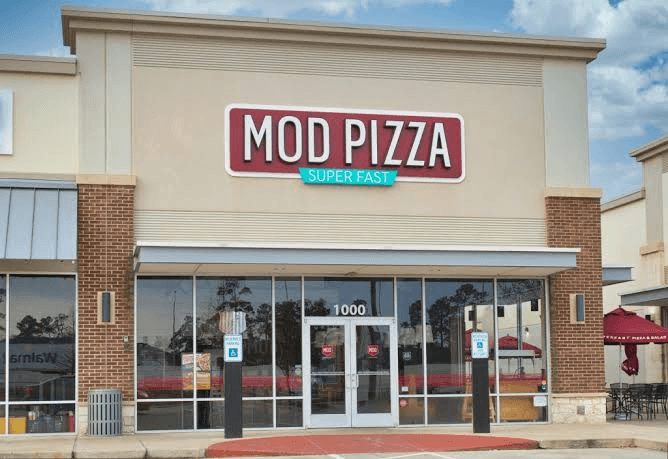
Customers across the country have shown up to their local MOD Pizza only to find it permanently closed — no warning, no explanation on the door. That experience has prompted a straightforward question: is MOD Pizza going out of business entirely?
The short answer is no — but the longer answer requires some context. MOD Pizza has gone through significant financial stress, closed dozens of locations, flirted with bankruptcy, and changed ownership. Here is what actually happened and what it means going forward.
MOD Pizza Has Not Shut Down, But It Is Much Smaller Than Before
MOD Pizza is still operating. As of late 2024, the chain has approximately 460 to 482 locations across the United States, plus a small presence in Canada. That number is meaningfully lower than where it stood at its peak.
Franchise disclosure documents show that around 70 restaurants closed during 2024 alone. Of those remaining locations, some are company-owned and some are franchised — but the brand itself is still active and serving customers.
It is worth distinguishing between a chain that is eliminating its entire footprint and one that is strategically shrinking. MOD falls into the second category. Closing underperforming stores is a restructuring move, not necessarily a death sentence for a brand.
Think of it like a major retail chain closing its weakest stores while keeping stronger ones open. The brand does not disappear — it contracts to a more sustainable size.
The Bankruptcy Reports — What Was Actually Said
In early July 2024, Bloomberg reported that MOD Pizza was preparing for a potential Chapter 11 bankruptcy filing, possibly within days. That headline caused a wave of concern among customers and employees.
However, a MOD spokesperson stated at the time that the company was “actively working” to avoid a Chapter 11 filing and was exploring strategic alternatives. The spokesperson also made clear that no plans were finalized and that the situation could change.
Ultimately, a formal bankruptcy filing did not happen. Instead, the company moved toward a sale — which became the resolution to the financial pressure it was facing.
It also helps to understand what Chapter 11 actually means. It is a reorganization tool, not a liquidation. Companies use it to restructure debt while continuing to operate. It is not the same as going out of business. Chapter 7, by contrast, is liquidation — where a company closes and sells its assets. MOD was never reported to be heading toward Chapter 7.
The Sale to Elite Restaurant Group and What It Changes
On July 10, 2024, MOD Pizza announced it had reached an agreement to sell itself to Elite Restaurant Group through a merger with an Elite affiliate. The deal was framed publicly as a way to restructure the company’s debt and avoid the bankruptcy filing that had been reported days earlier.
Elite Restaurant Group is a California-based operator with a track record of acquiring financially distressed restaurant brands. Restaurant Business described the company as a “collector of financially troubled restaurant brands.” Elite has been involved with other struggling chains before MOD.
For customers, this is a change in ownership and operational strategy — not a brand closure. The MOD name, menu concept, and remaining locations are expected to continue under Elite’s management.
What Elite’s involvement likely signals is further rationalization of underperforming units, lease renegotiations, and efforts to improve the overall capital structure. Turnaround operators typically cut what does not work and focus investment on what does. Whether that approach succeeds with MOD remains to be seen.
Why MOD Pizza Reached This Point
No single factor explains MOD’s financial difficulties. Several pressures built up over time and converged at once.
Overexpansion
MOD grew rapidly to become the largest fast-casual pizza chain in the United States. That growth came with locations that could not sustain profitability at scale. Accumulating too many underperforming units is a common problem for chains that expand faster than their economics can support.
Pandemic Impact
MOD cited declining sales during and after COVID-19 as a contributing factor. The pandemic disrupted foot traffic, dine-in habits, and consumer spending patterns across the restaurant industry. Combined with rising interest costs, these pressures put sustained strain on MOD’s unit economics long after lockdowns ended.
Labor Cost Pressures
California’s $20-per-hour fast-food minimum wage took effect in April 2024. Shortly before it did, MOD closed five California locations. Some media outlets framed this as a direct reaction to the wage increase.
MOD’s own statement offered a more nuanced explanation. The company said those closures were due to underperforming stores, with the wage increase serving as a contributing factor — not the sole cause. A spokesperson described the timing as largely coincidental.
That distinction matters. Attributing all of MOD’s California closures to the minimum wage law oversimplifies a situation driven by multiple factors, including unit-level performance that was already weak before the law changed.
Broader Closures Across the Country
In March and April 2024, MOD closed 26 to 27 restaurants across 11 states and Washington D.C. By early July 2024, the confirmed closure count had reached 44 for the year. Franchise disclosure filings put the full-year 2024 closure figure at approximately 70 locations.
Competition within the fast-casual segment and consumer sensitivity to rising menu prices added further strain. MOD was not the only chain dealing with these pressures, but its combination of high debt, overexpansion, and margin challenges made it more vulnerable than most.
What This Means for Customers and Employees
If your local MOD Pizza closed without warning, you are not alone. Sudden store closures have happened in markets across the country, from California to Missouri. For the customers affected, the experience understandably raises questions about the entire brand.
However, in markets where MOD locations remain open, those restaurants appear to be continuing normal operations under the MOD name. The brand has not announced any plans to wind down entirely.
For employees, the picture is more difficult. Workers at closed locations lost their jobs, sometimes with little notice. In some cases, transfers to nearby stores may have been available, but that depends on geography and staffing needs at each unit.
Gift card holders and loyal customers may reasonably wonder about future reliability. Monitoring local news and MOD’s official communications is the most practical way to stay informed, given how quickly the situation has been evolving.
What to Watch Going Forward
MOD Pizza’s situation as of mid-to-late 2024 is best described as serious but not terminal. The brand is under new ownership, operating a smaller footprint, and attempting a turnaround. Whether that attempt succeeds depends on factors that are still unfolding.
For those tracking the brand, a few signals are worth watching. A stabilized store count with fewer sudden closures would indicate the restructuring is gaining traction. New marketing or menu initiatives from Elite would suggest the new owner is investing in the brand rather than just managing a slow decline. Any formal bankruptcy filings — which have not occurred as of the reporting covered here — would indicate the financial situation has worsened again.
For a broader view on how distressed restaurant brands navigate ownership changes and what that means for consumers, Slick Business Mag covers similar business stories across the retail and hospitality sectors.
Industry context also matters. MOD is not the only fast-casual concept navigating a difficult post-pandemic environment. Segment-wide challenges around labor costs, consumer price sensitivity, and shifting dining habits have put pressure on multiple brands. MOD’s struggles reflect both its own strategic missteps and forces that extend well beyond any single company.
The Bottom Line
MOD Pizza is not going out of business in the sense of a total shutdown. It has closed a significant number of locations, come close to a bankruptcy filing it ultimately avoided, and sold itself to a new owner with experience in distressed restaurant brands.
What remains is a smaller chain under new management, working to stabilize after years of overexpansion and financial pressure. That is not the same as disappearing — but it is also not a clean bill of health. The brand’s long-term viability will depend on whether Elite Restaurant Group can turn the underlying economics around in the locations that remain open.
For now, MOD Pizza is still operating. Whether it continues to do so at a meaningful scale is a question that 2025 and beyond will answer more clearly than 2024 could.
Also Read This:
