


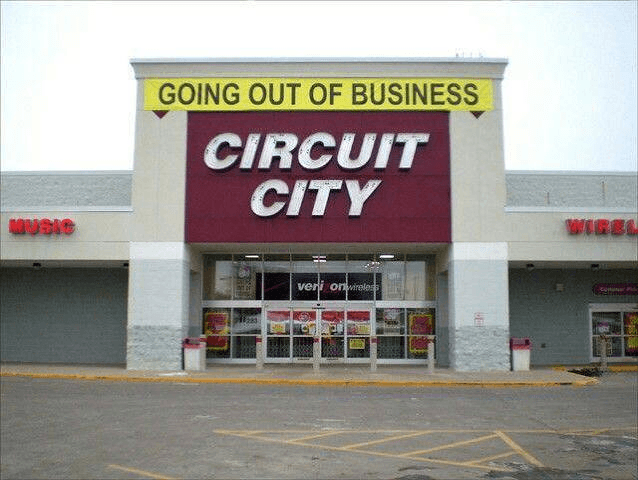
Many people still search for Circuit City online, wondering if the chain is currently closing, already gone, or somehow still operating in a new form. The short answer is that Circuit City already closed — permanently — back in 2009. But the full story is worth understanding, especially if you want to learn why one of America’s biggest electronics retailers collapsed so completely.
This article covers the current status of Circuit City, how the bankruptcy and liquidation unfolded, why the company failed, and what lessons other businesses can take from it.
Circuit City No Longer Exists as a Retail Chain
To be direct: Circuit City is not going out of business right now. It already did. The original Circuit City Stores Inc. closed all of its U.S. stores in early 2009 after a full liquidation sale. The last store shut its doors on March 8, 2009.
At its peak, Circuit City was the second-largest electronics retailer in the United States, operating more than 500 stores nationwide. When it collapsed, roughly 567 remaining locations were left empty. According to NBC Miami, those stores were left “broom clean and vacant.” CBS News reported that approximately 30,000 jobs were lost in the process.
It is worth noting that a separate company later acquired the Circuit City brand name and launched an online-only presence. That is not the same company. It is a brand revival by different owners, not a continuation of the original retail chain.
From a Richmond TV Shop to a National Retail Chain
Circuit City started small. It was founded in 1949 in Richmond, Virginia, as a modest television store called Wards Company. Over the following decades, it grew into a national big-box electronics retailer and helped define the superstore format for consumer electronics.
For a long time, Circuit City was genuinely influential. It was considered an industry innovator and built a loyal customer base across hundreds of locations. The fact that a 60-year-old institution collapsed so quickly is part of what made the story so widely studied and discussed in business circles.
The Bankruptcy Timeline — From Chapter 11 to Full Liquidation
The collapse did not happen overnight. Here is a clear sequence of what took place.
Before the Bankruptcy Filing
Even before the formal bankruptcy, Circuit City was already struggling. The company announced the closure of approximately 155 stores as an early cost-cutting move. This was a warning sign that deeper problems existed well before the 2008 financial crisis hit.
November 2008: Chapter 11 Filing
In November 2008, Circuit City filed for Chapter 11 bankruptcy protection. This is not the same as closing. Chapter 11 gives a company legal protection from creditors while it tries to reorganize and keep operating. The plan at the time was to stay open through the holiday season and find a path forward.
According to CNET, the company intended to use the bankruptcy process to restructure its debts and continue operating. That plan did not work out.
January 2009: The Decision to Liquidate
After failing to find a buyer or secure financing, Circuit City asked the bankruptcy court for permission to liquidate all remaining 567 U.S. stores. Four liquidator firms were appointed to handle the sales: Great American Group, Hudson Capital Partners, SB Capital Group, and Tiger Capital Group.
The liquidation involved roughly $1.7 billion in inventory and moved faster than many expected. CBS News and Network World both confirmed the scale of the closure and the approximate 30,000 job losses that followed.
March 8, 2009: The Last Store Closes
By early March 2009, it was over. The Federal Reserve Bank of Richmond confirmed that the last Circuit City store closed on March 8, 2009, ending a 60-year run. As is typical in full liquidations, shareholders received nothing.
Why Circuit City Failed While Best Buy Survived
This is the question most people really want answered. The 2008 financial crisis played a role, but it was not the main cause. Circuit City entered the downturn already weakened by years of poor strategic decisions. The crisis accelerated a collapse that was already building.
Firing Experienced Staff to Cut Costs
One of the most damaging moves Circuit City made was firing thousands of its more experienced, higher-paid salespeople and replacing them with lower-paid workers. The idea was to reduce payroll costs. The result was a sharp drop in service quality at exactly the time customers had more choices than ever.
Think of it like an airline that cuts costs by replacing its most experienced crew with cheaper, less trained staff. The short-term savings come at a serious cost to quality and customer trust. Circuit City made this trade-off and lost.
A Worse In-Store Experience
Over time, Circuit City stores became cluttered and harder to navigate. Compared to Best Buy’s cleaner layouts and more organized presentation, the in-store experience at Circuit City felt outdated. Customers noticed, and many stopped coming back.
Best Buy, meanwhile, invested in its store environment and launched the Geek Squad, which gave customers a reason to choose it beyond just price. Circuit City had no comparable answer.
A Weak Response to Online Competition
As Amazon and other online retailers grew, consumers began researching and buying electronics from the comfort of their homes. Best Buy moved to build a stronger online presence and integrated it with its physical stores. Circuit City’s e-commerce strategy was slower and less effective.
According to analysis from InspireIP and the Federal Reserve Bank of Richmond, this failure to adapt to shifting consumer behavior was a major factor in the company’s decline.
Strained Vendor Relationships
Circuit City also had problems with key suppliers. Strained vendor relationships led to inventory management issues and slow stock turnover. Best Buy maintained stronger partnerships with major brands, which helped it secure better product availability and terms. Circuit City’s supply chain problems compounded its other difficulties.
Solving the Wrong Problem
Writing for Inc., analyst Peter Cohan framed Circuit City’s failure as a case of management focusing on the wrong problems. Instead of asking why customers were choosing competitors and how to improve the overall value offered, leadership focused narrowly on cutting labor costs. The result was a company that spent energy on short-term savings while ignoring the fundamental reasons it was losing ground.
The 2008 financial crisis then acted as a final stress test. Stronger companies bent under the pressure. Circuit City, already structurally weakened, broke.
The Post-2009 Brand Revival
After the original company shut down, the Circuit City brand name was acquired by a separate entity and used for an online-only retail presence. This is not a continuation of the original business. It is a new operation using a recognizable name.
If you have seen “Circuit City” mentioned online in recent years, that is likely what you are seeing — a brand revival, not a resurrection of the chain that once operated hundreds of physical stores. The original corporate entity, Circuit City Stores Inc., no longer exists.
Business Lessons From the Circuit City Collapse
The Circuit City story is a useful case study for anyone thinking about business strategy, retail, or investment risk. A few clear lessons stand out.
- Cost-cutting is not a strategy. Reducing payroll by firing your best staff may look good on a quarterly report, but it erodes the customer experience that drives revenue in the first place.
- Adapt to where customers are going. The shift to online shopping was visible years before Circuit City collapsed. Companies that responded early fared much better than those that waited.
- Focus on the right problems. Management has to identify the actual reasons customers are leaving — not just the most convenient numbers to cut.
- Store experience matters. In a market where customers can buy online, a physical store needs to offer something worth visiting. Circuit City stopped offering that.
- Shareholders bear real risk. When a company moves from Chapter 11 reorganization to full liquidation, equity holders typically receive nothing. Circuit City’s shareholders lost everything.
For more analysis on business strategy, retail trends, and corporate case studies, Slick Business Mag covers these topics with a practical, no-nonsense approach.
The Bottom Line
Circuit City is not going out of business — it already did. The chain permanently closed all of its U.S. stores in early 2009 after a bankruptcy process that moved from reorganization to full liquidation. Approximately 567 stores closed, roughly 30,000 people lost their jobs, and shareholders received nothing.
The collapse was not simply the result of a bad economy. It was the outcome of years of strategic missteps — poor staff decisions, a weaker store experience, slow adaptation to e-commerce, and a management approach that focused on cutting costs rather than solving the real competitive challenges the company faced.
Best Buy survived the same environment because it made different choices. That contrast remains one of the clearest examples in modern retail of how strategy — not just market conditions — determines which companies endure.
Also Read This:
